
Overview
There are twelve tables under the Utilization and Quality tab on the Facility Analyze page. These tables will help you to perform a detailed analysis of the selected facility's performance, specifically regarding care for home health patients. The numerous metrics will help you to evaluate the facility's operational success as well as the post-acute experience of patients after discharge from the facility.

- In this article, "facility" could refer to any organization that treated patients who were subsequently admitted to home health services. As a shorthand, you can think, hospitals and skilled nursing facilities.
- Also, since many of the tables pertain only to metrics from inpatient claims, those tables will not appear on the facility Analyze page when viewing a selected skilled nursing facility, even if that facility treated numerous patients who were subsequently admitted to home health care.
 In this article
- Patient Home Health Utilization - counts of patients treated by the selected facility who were subsequently admitted to home health care - an insight into the flow on the continuum of care
- Trended Readmission Rates - This table provides a four quarter trend of readmission rates for the selected facility
- Home Health Agency Length of Stay Post Discharge - four quarter trend of average lengths of stay at home health agencies for the selected facility
- Discharge Events by Setting - Inpatient - shows the flow of patients from the discharging facility to numerous post-acute destinations
- Outcomes by Setting: Outpatient - provides insights into the post-acute care provided to patients discharged from the selected facility - mortalities and readmission rates
- Patients Discharged with Home Health Instructions (Inpatient only) - This table allows you to compare the impact of home health care for patients discharged from the selected facility. All patients coded for home health care at discharge are compared between two groups - those who were admitted to a home health agency and those who weren't admitted to home care.
- Patient Diagnostic Mix - breaks down the selected facility's discharged patients by the principle diagnosis indicated on the discharge claim and provides metrics for trended patient counts, home health utilization, average length of stay, and readmission rates, with state and county comparisons
- Outpatient Groups - this table provides a breakdown of patients treated at the selected facility and identified as having received outpatient care on the claim
- Inpatient MS-DRG Breakout - breaks down the selected facility's patients by the MS-DRG indicated on the discharge claim and provides metrics for patient counts, average length of stay, and readmission rates, with state and county metrics included for comparison
- CMS TEAM Episode Category - patient counts, ALOS, and readmission rates for the selected facility broken out by the five CMS TEAM episode categories
- BPCI Groups - breaks down the selected facility's patient counts by the BPCI bundled payment types and provides metrics for trended readmission rates, home health utilization, average length of stay, and readmission rates with state and county metrics included for comparison
- Readmission Groups - patient counts, readmission rates, and Medicare reimbursement for patients admitted to the selected facility broken out by readmission groups
 Some of these tables can be viewed as either a table or a chart. Use the selector at the top left of the table to turn charts on or off. Some of these tables can be viewed as either a table or a chart. Use the selector at the top left of the table to turn charts on or off. |
 |
Location
These tables will be found under the Utilization and Quality tab of the Analyze page for a facility.

Understanding the Metrics
Patient Home Health Utilization
The metrics in this table represent trended percentages, by quarter, of the selected facility's patients who were admitted to home health services within 30 days of discharge from the selected facility during the one-year reporting period.

Patient HHA Utilization - (Entered)
This metric is the percentage of facility discharges that resumed or started a new home health stay within 30 days of discharge. This reflects a one-year reporting period ending in the specified quarter.
Consider the following simplified calculation.

This percentage is based on patients who were admitted to home care within 30 days of discharge from the selected facility and includes both patients intended for home health care (coded for HH care at discharge) and patients who were coded for other care.
Facility's intended HHA Utilization - (Coded)
Metrics in this row are the percentage of facility discharges that were coded for home health services at discharge (% Coded). This reflects a one-year reporting period ending in the specified quarter.
The following image shows the basic formula.

As implied, this metric identifies the percentage of patients who were coded for home health care at discharge, indicating that the intention was for the patient to seek home care after discharge. The percentage includes both patients who were admitted to home care and those who weren't admitted to home care. Patients who weren't admitted to home care might have been admitted to other post-acute care.
Facility's actual HHA Utilization - (Adhered)
This is the percentage of facility discharges that were coded for home health services and resumed or started a new HH stay within 30 days of discharge (% Adhered). This reflects a one-year reporting period ending in the specified quarter.
The following formula shows the numerator and denominator for this metric.

This metric is calculated on patients who were intended for home health care (coded at discharge) who were also admitted to home care within 30 days of discharge.
Chart View
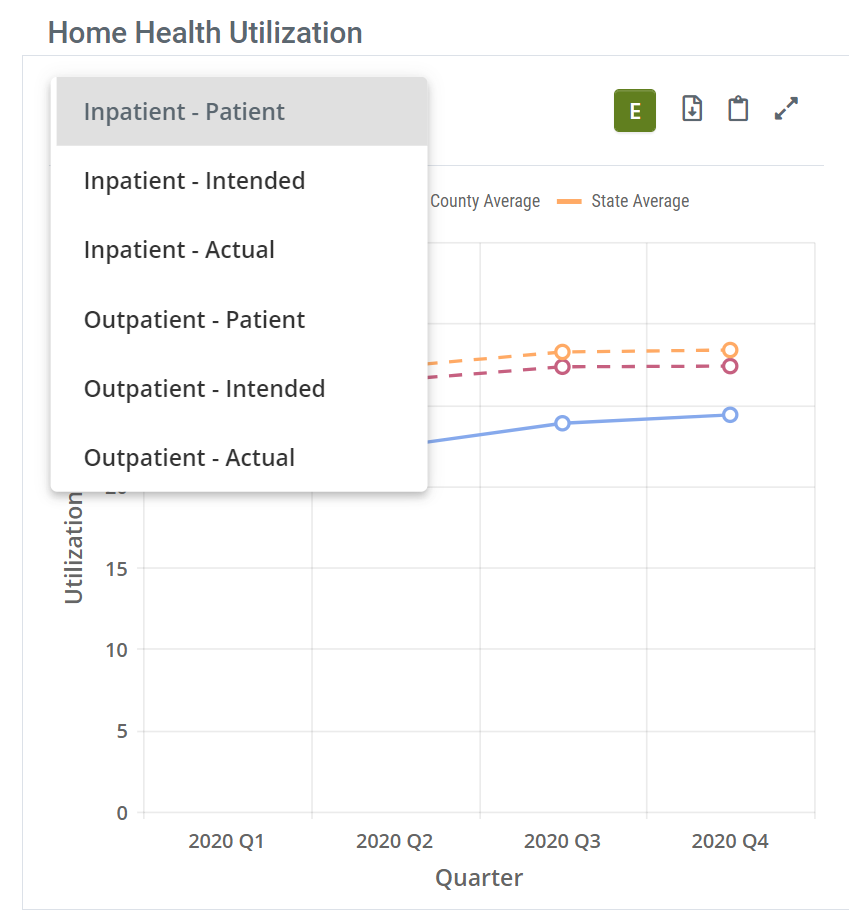
With Chart view on, you get a slightly different view of the metrics from the table view. The chart view includes county and state benchmarks for comparison. (see image.)

There are six versions of this table which you can select with the dropdown. The top three, inpatient align with the different percentages described above in the section on the table. So, for example, if you select Inpatient - Intended, you will get trended percentages of patients who were coded for home health care at discharge.
Outpatient
For outpatient claims, we use the same method for identifying patient, intended, and actual counts. Since the vast majority of outpatient visits have no subsequent care required, that is, the patient goes home, the utilization metrics for those three options in this chart will be small.
 |
Trended Readmission Rates
A readmission is a multi-claim event where a patient is discharged from an inpatient stay at a short term acute care hospital and is readmitted to inpatient care again within 30 days. This readmission scenario could include a post-acute stay, or multiple post-acute stays during that 30 day period. The goal of a readmit rate is to evaluate each facility's success at keeping patients out of the hospital.
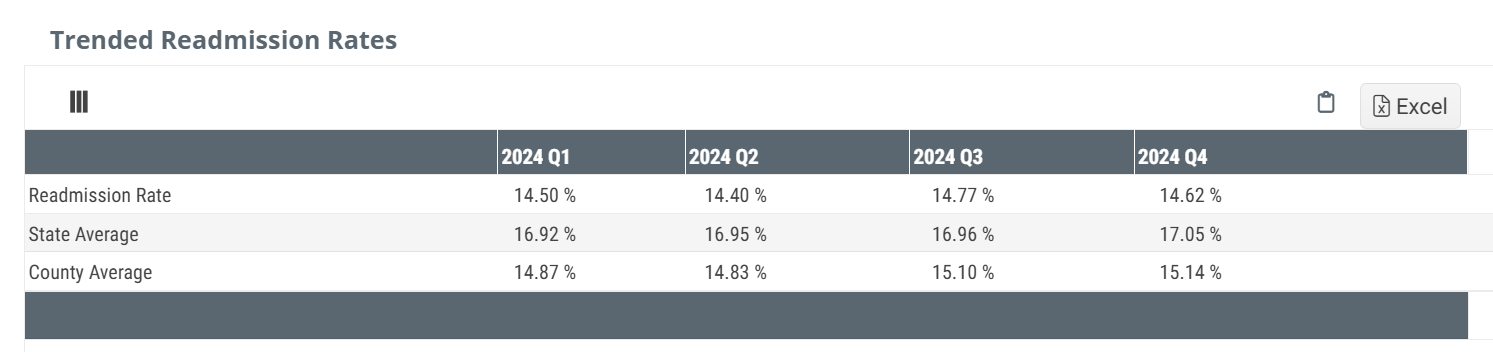
This table includes a trend of readmission rates over the most recent four quarters. The state and county comparison metrics cover all similar facilities in the stated area for the same period.
 Because this metric is calculated for a one year period, this metric will not match other readmit rates listed under the last reported quarter in other locations in Trella Insights. In addition, because of the shortened reporting period, you will notice a higher number of Readmit rates that are not reported to comply with privacy suppression.
 For more information, see Readmission Rates also, Trended Readmission Rates.
|
Home Health Agency Length of Stay Post-Discharge
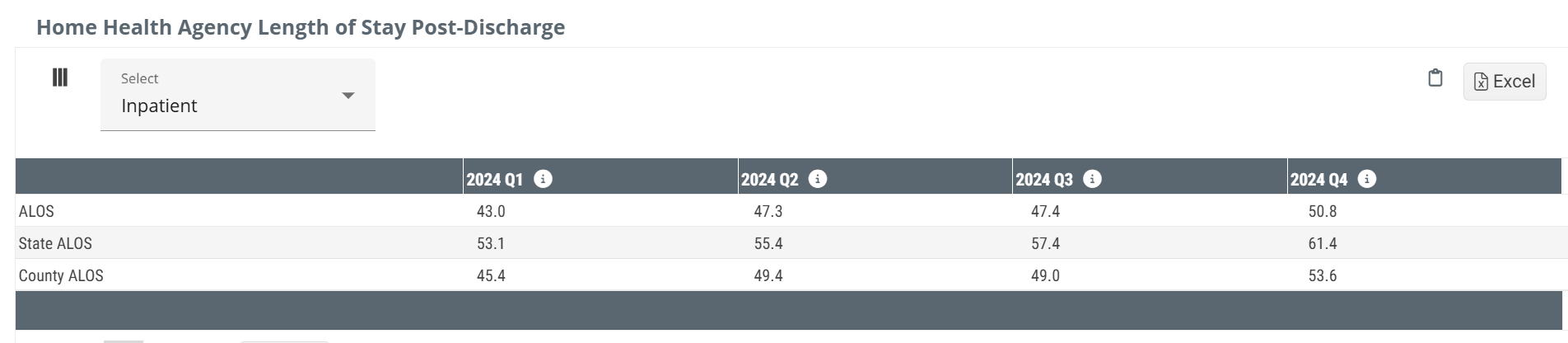
The table contains trended average length of stay metrics for the most recent four quarters with state and county averages for comparison.
 Calculation
How Trella Health calculates the metrics in this table:
- For a patient to be included in the count, they must have been admitted to home health care within 30 days of discharge from the selected facility
- From those patients, we identify patients who were discharged from home health care during the quarter listed in each column
- For patients that meet both of the above criteria, we calculate the total number of days those patients received home health care, looking back for the date of admission up to two years from the end of the most recent quarter of data available
- To calculate the length of stay average, we divide that total number of days by the count of patients that met the original inclusion criteria
Because these metrics are calculated for a period of a single quarter, this metric will not match other average length of stay metrics listed under the last reported quarter in other locations in Trella Insights. This table is used specifically to identify quarter over quarter trends.
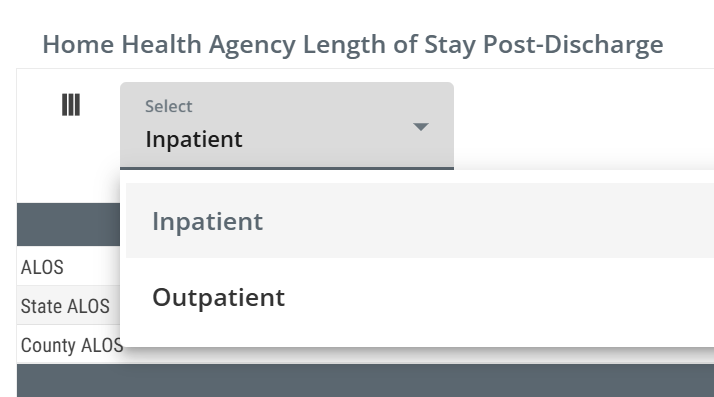
The dropdown selector at the top-left of the table allows you to switch between inpatient and outpatient claims for patients discharged from the selected facility. The table will show length of stay counts that reflect your choice.
For more information, see Average Length of Stay.
|
Discharge Events by Setting - Inpatient
Imagine that a patient is about to be discharged from a hospital. The discharge planning team evaluates the patient and determines that the patient should continue care from a specific type of post-acute provider. They record this "status" on the discharge claim. This table shows the collection of those discharge events and the outcomes for those patients as they moved on from the selected facility to additional care.
Notice that the table is titled, Discharge Events. The reason is that the counts in this table are not counts of patients. If a single patient had multiple discharges during the reporting period, each discharge would be counted in this table.
However, If you think of an individual patient, for a moment, this will make the table more clear. There are a few possible scenarios from the perspective of home health providers:
- The patient had a status for home health care at discharge, and the patient was admitted to home health care. We call this adherence. (In the table, this is the column, Discharges Adhered to PAC (Entered).)
- The patient had any other status than home health at discharge, and the patient was admitted to home health care. (This column would be Entered not Coded, that is, the patient entered home health care even though not coded to seek home health care at discharge.)
- The patient had a status for home health care at discharge, but the patient either didn't receive any post-acute care, or the patient was admitted to another form of post-acute care. (Patients who follow this path are counted in the column, Intended, Not Adhered.)
For more information, see How does Trella Health Identify Status Coding?

Metrics Summary
- Discharge Destination - think of this as Patient Pathway. In this column we identify which post-acute destination the inpatient discharges were admitted to.
Example: INP to HHA (Total) indicates that the metrics in this row pertain to patients who were discharged from inpatient care and were admitted to home health care.
- Discharges Coded for PAC (Intended) - This is the count of discharge events that were coded with the status that aligns with the post-acute care listed in the same row. From the image above, for INP to HHA (Total), the number 4,874 indicates the number of discharges during the reporting period for which the status coding indicated home health as the "intended" next post-acute care for those patients discharged.
It is important to remember that status coding does not equate to a referral, further guidance, or teaching in any way with regard to additional care. We use this table to understand the flow of patient populations and how well they align with discharge expectations.
- Discharges Adhered to PAC (Actual) - In short, this column contains the count of discharges where the patient was coded for the type of post-acute care listed in the row and the patient was admitted to that level of care within 30 days of discharge.
Special example: in the row INP to HHA, the discharge would be counted in the Discharges Adhered to PAC column if the patient was discharged, was admitted to SNF care, and then was admitted to home health care all within 30 days. Since the home health admission took place within 30 days, this is considered "adherence" even with the intervening SNF admission. Also, the discharge in this example would also be counted in the INP to SNF row under the column, Entered, not Coded.
- Discharges Admitted to PAC (Entered) - This is a count of all discharges from the selected facility that were admitted to the post-acute care setting listed in the row within 30 days of discharge. This count includes those who received any status at discharge. Another way of viewing this count, the number is a count of home health admissions and do not reflect status coding at discharge from the selected facility.
- Intended, Not Adhered - Opportunity #1! - This is the count of discharges who were coded for a specific post-acute setting but who were not admitted to that type of care within 30 days of discharge.
- Entered, not Coded - Opportunity #2! - This is the count of the discharges who were admitted to the type of care listed in the row within 30 days of discharge, but the initial status coding at discharge was not aligned to the patient's post-acute destination.
- Adherence Rate - This is the percentage of discharges who adhered to the coding status at discharge. (Calculation: Adhered/Intended * 100%)
It is possible that a patient could be admitted to more than one post-acute setting within the 30 days after discharge. Each pair of discharge and admission events within 30 days will be counted in the appropriate column. Example: A patient is discharged with a status for SNF, and is admitted to a SNF, but is then admitted to hospice, all within 30 days. The following would receives "counts" in this scenario
| Inpatients | Intended | Actual | Entered | Intended, not adhered | Entered, not Coded |
| INP to HOS | X | X | |||
| INP to SNF | X | X | X |
Even though a patient is coded for a specific type of post-acute care, this should not be taken as an indication that patient instruction of any kind was provided. The claims indicate the chosen status at discharge but do not contain any other insights into what took place at discharge. In other words, this table is best used to understand intention and results, not to count referrals.
The content on this table is intended to be introductory - for usage information and more detail, see Discharge Events by Setting.
For more information on the category, "other," see Facilities Analyze page - What is "Other?"
TEAM Insights
|
The dropdown at the top left of the table allows you to choose one of the five TEAM Episode categories. Selecting a specific category will limit the metrics in the Discharge Events by Setting table to discharges from the selected hospital that align with the selected chosen category. Click on a single option from the dropdown list. |
 |
|
Outcomes by Setting: Inpatient
This table is the flip side of the table, Discharge Events by Setting. That table answers the question, "After Discharge, where'd everybody go?" This table answers the question, "What happened when they got there."
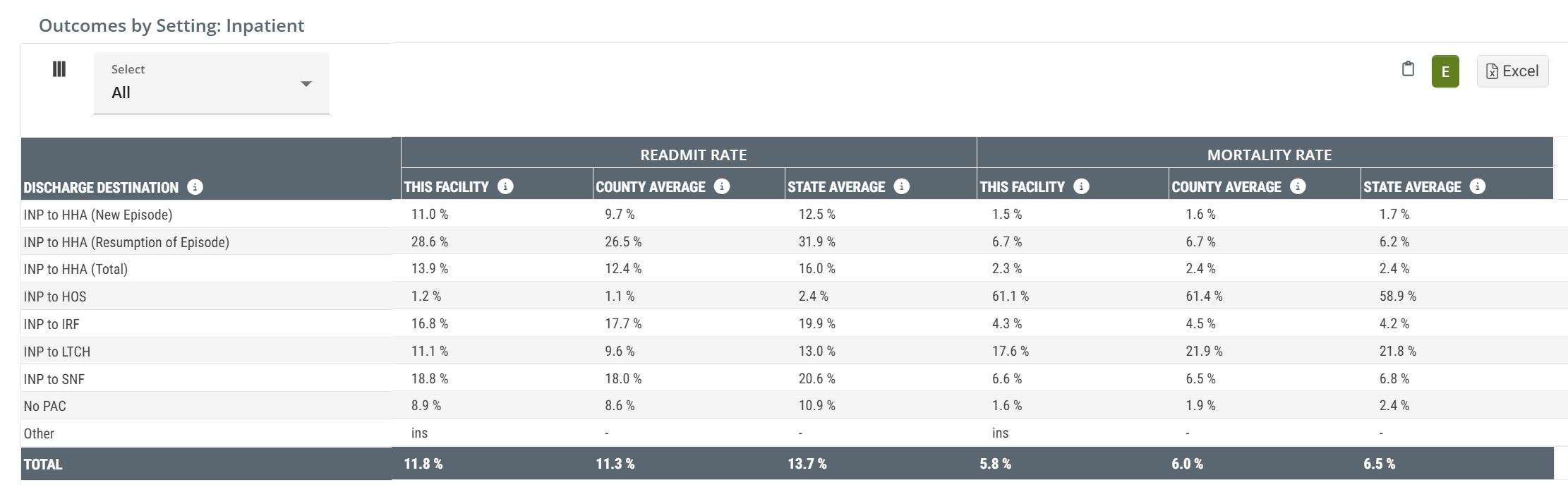
This action-packed table provides several insights into the post-acute care provided to patients discharged from the selected facility. Readmit rates and mortality rates are calculated for several different post-acute destinations with county and state averages available as benchmarks for comparison.
The Outcomes by Setting table will only have an Inpatient version for selected hospitals and a SNF version for selected Skilled Nursing Facilities. The image below is for a hospital. For a selected SNF, the table will be identified by "SNF," instead of "Inpatient," or "INP."
Metric Summaries
- Inpatient - Think of this as Patient Pathway. In this column we identify which post-acute destination the inpatient discharges were admitted to.
Example: INP to HHA indicates that the metrics in this row pertain to patients who were discharged from inpatient care and were admitted to home health care.
-
Readmit Rate - This is the percentage of discharges from the selected facility who were admitted to the type of post-acute care listed that were readmitted to a hospital within 30 days of the initial discharge. Another way of looking at this is that this is the readmission rate for the selected facility calculated from the subset of patients who entered the listed post-acute care setting.
- State and county benchmarks are included for comparison.
For more information on Readmission rates, see Readmission Rates.
- Mortality Rate - This is the rate at which patients expired within 30 days of discharge from this facility following admission to the type of post-acute care listed.
For more information on the category, "other," see Facilities Analyze page - What is "Other?"
The content on this table is intended to be introductory - for usage information and more detail, see Outcomes by Setting.
TEAM Insights
|
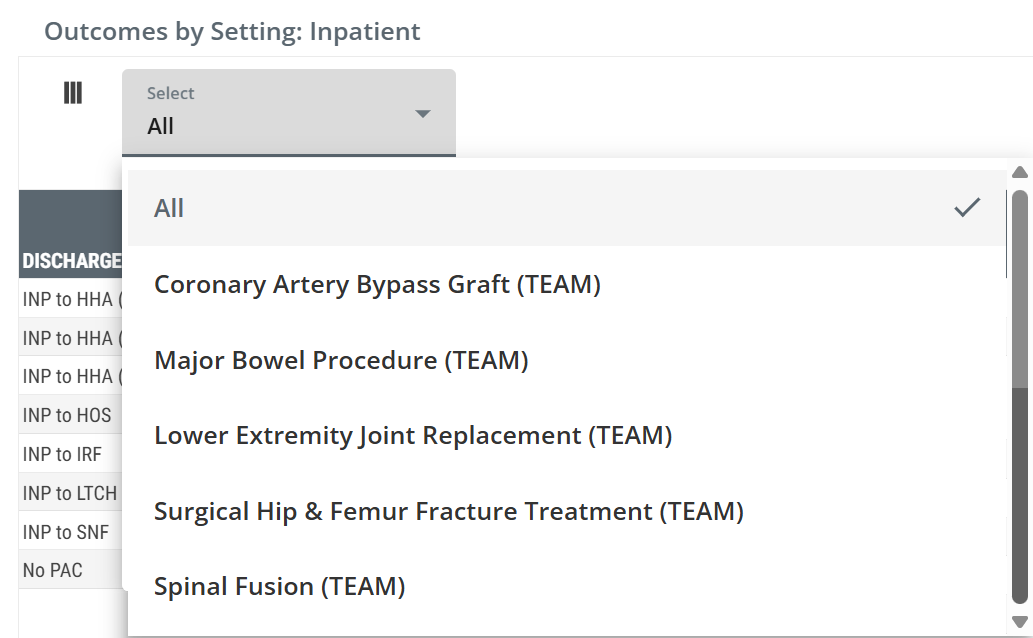
The dropdown at the top left of the table allows you to choose one of the five TEAM Episode categories. Selecting a specific category will limit the metrics in the Outcomes by Setting: Inpatient table to discharges from the selected hospital that align with the chosen episode category. Click on a single option from the dropdown list. |
 |
|
Patients Discharged with Home Health Instructions (Inpatient Only)
This table shows the impact of home health care on the patients discharged from the selected facility. For all patients discharged who were coded for home health, we compare metrics for three possible outcomes:
- Patients admitted to home health as a new stay - in the first row, "Patients admitted to Home Care."
- Patients admitted to home health as a resumption of care - in the second row, "Patients Resuming Home Care."
- Patients who were not admitted to home care - this could mean they were admitted to another post-acute setting or just went home - in the bottom row, "Patients not admitted to Home Care."
For each outcome we calculate a patient count and performance metrics specific to the patients for whom the listed outcome applies. The performance metrics have county and state benchmarks for comparison.

Metric Summaries
- Total - This is the count of patients who were coded for Home Health at discharge from the selected facility relative to the outcome in the row header.
- Percentage of all Inpatient - This metric is the percentage of all inpatient discharges for whom the outcome in the row applies.
- Percent of all Patients who Received Instructions - The percentage of patients who were coded for home health at discharge from the selected facility for the outcome in each row
The header contains the word "Instructed." The metrics below are calculated from the status coding on the discharge claim. Status coding suggests the intention at discharge, but does not indicate that any instructions were provided to the patient.
- % Readmitted: 30 Days - the percentage of patients for each listed outcome who were readmitted to inpatient care within 30 days
|
Patient Diagnostic Mix
This table breaks out several key metrics by the Trella Health Diagnostic Categories. This will allow you to zoom in on areas of strength based on more narrow patient populations.
 To enlarge this image, click on it.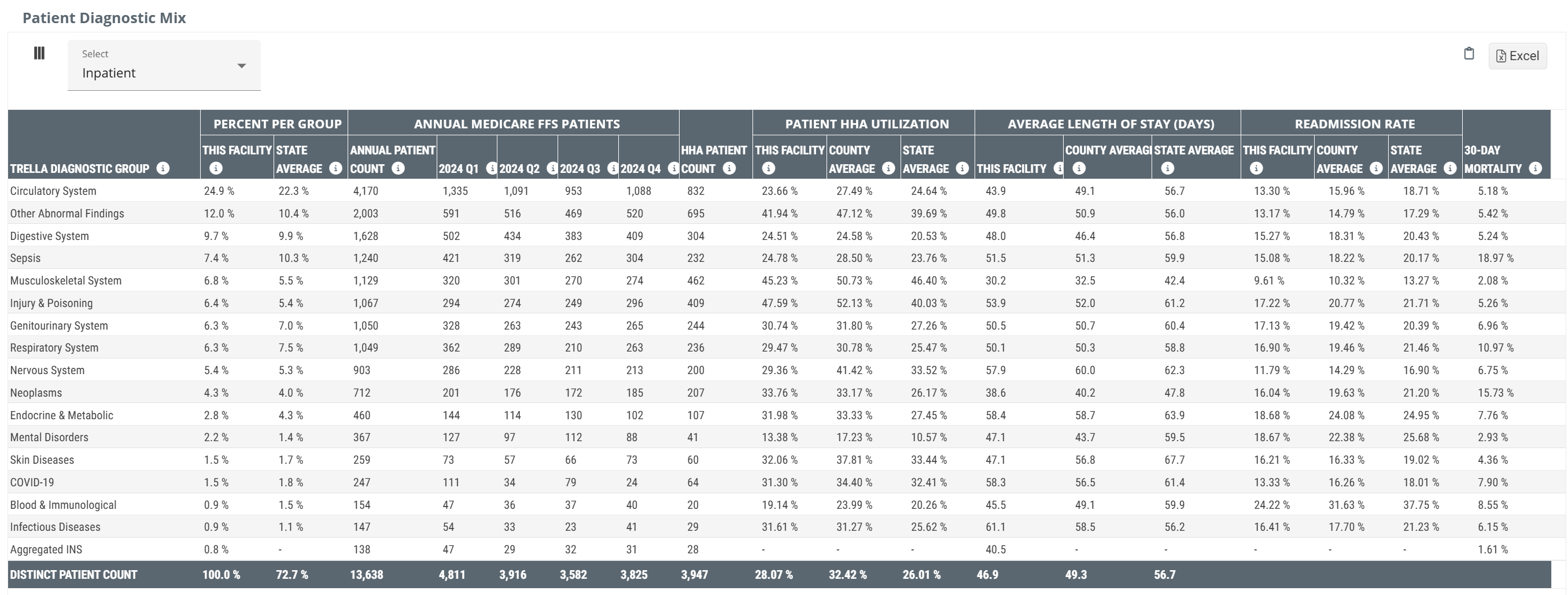
Metric Summary
The following list includes summaries of each section. Please go to the full article for more details and links.
All state and county benchmarks are calculated from claims submitted by similar facilities in the same state or county as the selected facility.
- Trella Diagnostic Group - This column identifies the Trella Health diagnostic Group for the metrics in each row
- Percent per Group - This metric is the percent of the selected facility's Medicare patients who had a primary diagnosis code included in the diagnostic category in each row
- Annual Medicare FFS Patients - This is the count of the selected facility's Medicare patients who had a primary diagnosis code included in the listed diagnostic category in each row during the one-year reporting period. The quarterly metrics are calculated from the quarter listed as the reporting period
- HHA Patient Count - This count is a subset of Annual Medicare FFS Patients - Annual Patient Count. It is the count of the selected facility's Medicare patients who had a primary diagnosis code included in the listed diagnostic category in each row and who were admitted to home health care within 30 days of discharge
- Patient HHA Utilization - This metric is the percentage of the selected facility's "Total" Medicare patients who had a primary diagnosis code included in the listed diagnostic category and were admitted to home health care within 30 days of discharge
- Average Length of Stay - This metric is the average length of stay (in days) in home health care for patients who had a primary diagnosis code included in the listed diagnostic category and who were admitted to home health care within 30 days of discharge from the selected facility
- Readmission Rate - This is the percentage of patients who had a primary diagnosis code included in the listed diagnostic category who were readmitted to a hospital within 30 days of the initial discharge from the selected facility
- 30 Day Mortality - This metric is the rate at which patients discharged from the selected facility expired within 30 days of discharge
Aggregated INS
There is an entry titled, “Aggregated INS” which represents the combined percentage for all diagnostic groupings that are too small to be presented on their own. In any case where the total number of patients in a specific diagnostic grouping drops below 11 patients, we can't show that number for privacy reasons. We roll all diagnostic groupings that represent counts <11 into this one category and present that count with this header. In sum, this row includes all diagnostic groupings that have insufficient counts aggregated into a single metric.
Inpatient/Outpatient
| The dropdown at the top left of the table will allow you to change whether the table reflects inpatient or outpatient claims. | 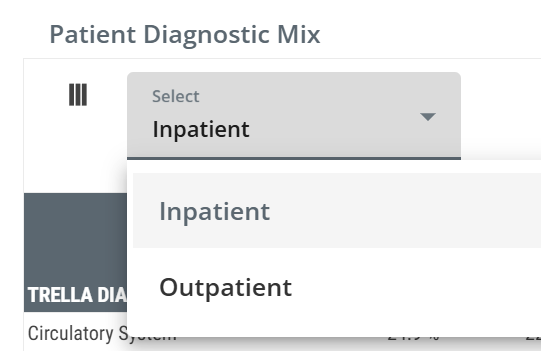 |
|
Outpatient Groups
The Outpatient Groups table includes some basic metrics that will help you to understand the patient population as compiled from outpatient metrics submitted by the selected facility.

Metric Summary
- Trella Outpatient Group - this row header identifies the Trella Outpatient Group assigned to the procedure (HCPCS) code listed on the outpatient claim. The metrics in the row align with the listed Outpatient Group.
- Percentage of Patients - this metric is the percentage of patients discharged from the facility with an outpatient procedure code that was assigned to the listed Trella Outpatient Group. The state average for all matching facilities in the state is provided for comparison.
- Annual Medicare FFS Patients - the count of distinct Medicare FFS patients discharged from the selected facility with an outpatient procedure code that was assigned to the listed Trella Outpatient Group. The table includes a count from the most recent year available and counts for each quarter in that year to show any recent trends in patient counts.
- Average Medicare Reimbursement - the dollar amount is the average Medicare reimbursement for all outpatient visits assigned to the listed Trella Outpatient Group.
|
|
|
Inpatient MS-DRG Breakout
This table contains counts and percentage of patients discharged from the selected facility broken out by Diagnostic Related Group (DRG). For each DRG we have included patient metrics, length of stay metrics, and readmission rates.
 This highly detailed view of patient diagnoses provides insights into areas of specialization where you might be able to develop a partnership with a specific hospital. Start by knowing which DRGs represent diagnoses for which your care is excellent. Then evaluate the selected hospital of interest to see if that DRG represents an area of need.
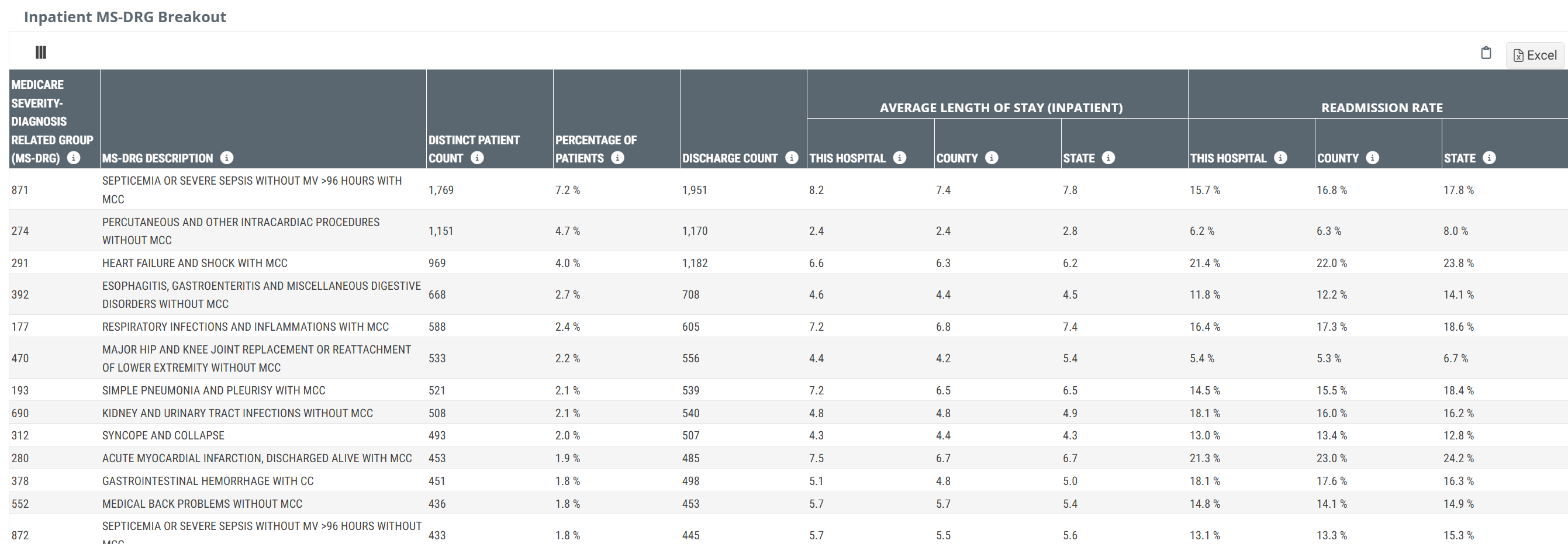
The Average Length of Stay metrics are for the inpatient stay. For any DRG where you excel, look for an ALOS longer than the state average. Building a trust relationship with a hospital in that situation may allow you to help by getting patients into post-acute care faster if they know you will provide excellent care for their patients. This will help the hospital to lower their inpatient ALOS.
Metric Summary
Metric/Column |
Description |
|
| Medicare Severity - Diagnostic Related Group (MS-DRG) | This column shows the MS-DRG code for the Diagnosis Related Group (DRG) listed on the inpatient claim. | |
| MS-DRG Description | This is the description of the DRG listed on the inpatient claim. | |
| Distinct Patient Count | The count of distinct patients discharged with the DRG listed on an inpatient claim during the two-year reporting period. | |
| Percentage of Patients | The percentage of patients with the listed DRG on an inpatient claim during the two-year reporting period. | |
| Discharge Count | The count of stays discharged with the DRG listed on an inpatient claim during the two-year reporting period. | |
| Average Length of Stay | This Hospital | The average length of stay (in days) spent in this hospital for patients that had the DRG listed on an inpatient claim during the one-year reporting period. |
| County | For the selected hospital's county, this metric is the average length of stay (in days) for patients who had the DRG listed on an inpatient claim during the one-year reporting period. | |
| State | For the selected hospital's state: The average length of stay (in days) for patients who had the DRG listed on an inpatient claim during the one-year reporting period. | |
| Readmission Rate | This Hospital | The percentage of patients who had the DRG listed on an inpatient claim during the two-year reporting period and were readmitted to a hospital within 30 days of discharge from the selected facility. |
| County | For the selected hospital's county: The percentage of patients who had the DRG listed on an inpatient claim during the two-year reporting period and were readmitted to a hospital within 30 days of the initial hospital discharge. | |
| State | For the selected hospital's state: This metric is the percentage of patients who had a DRG on an inpatient claim during the two-year reporting period and were readmitted to a hospital within 30 days of the initial hospital discharge. | |
DRG's with less than 11 patients (or DRG's that represent less than 1% of total inpatient stays) are excluded from this table.
|
CMS TEAM Episode Category
The CMS TEAM Episode Category table provides metrics for the selected facility with a focus on the five TEAM episode categories. At a glance, you will be able to determine the volume of patients treated by the selected facility for each of the five TEAM episode categories along with length of stay metrics and readmission rates.
Unlike many of the tables under this tab, the CMS TEAM table will not be shown for skilled nursing facilities.

Metric Summary
- TEAM Episode Category - this column shows the Transforming Episode Accountability Model (TEAM) Episode Category for which the metrics in the same row are calculated
- Distinct Patient Count - the metrics in this column are counts of distinct patients discharged with an inpatient MS-DRG associated with the listed TEAM episode category during the two-year reporting period
- Percentage of Patients - the percentage of patients discharged with an inpatient MS-DRG associated with any of the five TEAM episode categories who were discharged with an inpatient MS-DRG associated with the TEAM episode category listed in the row. This metric is calculated for the two-year reporting period
This metric is calculated from all patients discharged from the selected facility with an inpatient MS-DRG that aligns with a TEAM episode category.

-
Discharge Count - the metrics in this column are the counts of stays discharged with an inpatient MS-DRG associated with the listed TEAM Episode Category during the two-year reporting period. The count of stays can be higher than the count of distinct patients if some patients were discharged from multiple stays within the reporting period.
- Average Length of Stay (Inpatient) - the average length of stay (in days) spent in this hospital for patients discharged with an inpatient MS-DRG associated with the listed TEAM Episode Category during the two-year reporting period. County and state lengths of stay are provided for comparison.
- Readmission Rate - the percentage of patients discharged with an inpatient MS-DRG associated with the listed TEAM Episode Category during the two-year reporting period who were readmitted to a hospital within 30 days of discharge from the selected facility.
|
|
|
BPCI Groups
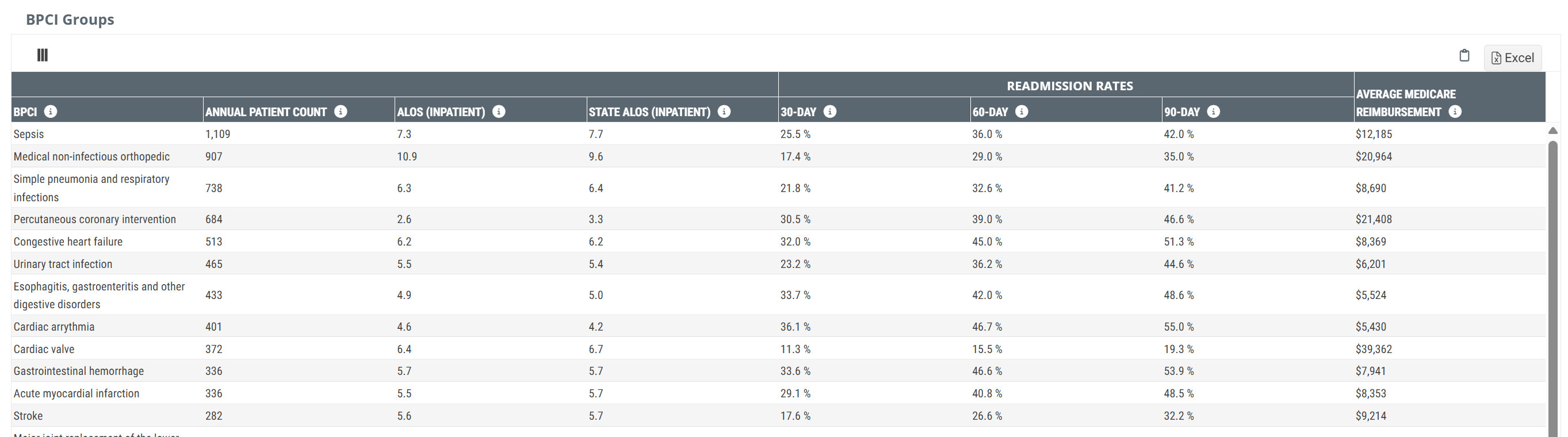
The BPCI Groups table breaks down the selected facility's patients by the bundled payment types and provides metrics for trended readmission rates, average length of stay, readmission rates with state and county comparisons, and average Medicare spend.
Metrics Summary
- BPCI - the Bundled Payment for Care Improvement (BPCI) category. Metrics in the same row are calculated based on claims for which the diagnosis aligns with the listed BPCI category
- Annual Patient Count - the count of distinct patients admitted to the selected facility during the one-year reporting period with diagnoses that aligned with the listed BPCI category
-
ALOS (Inpatient) - the average length of stay at the selected facility for patients discharged from the facility during the one-year reporting period whose diagnosis aligned with the listed BPCI category
- State ALOS (Inpatient) - the average length of stay at all facilities in the same state as the selected facility for patients discharged during the one-year reporting period whose diagnosis aligned with the listed BPCI category
- Readmission Rates - the readmission rate for patients discharged during the two-year reporting period with a diagnosis that aligned with the listed BPCI category who were readmitted to inpatient care within 30, 60, and 90 days of the initial discharge
- Average Medicare Reimbursement - the average Medicare reimbursement for all inpatient stays that match the listed BPCI category during the two-year reporting period
|
|
|
Readmission Groups
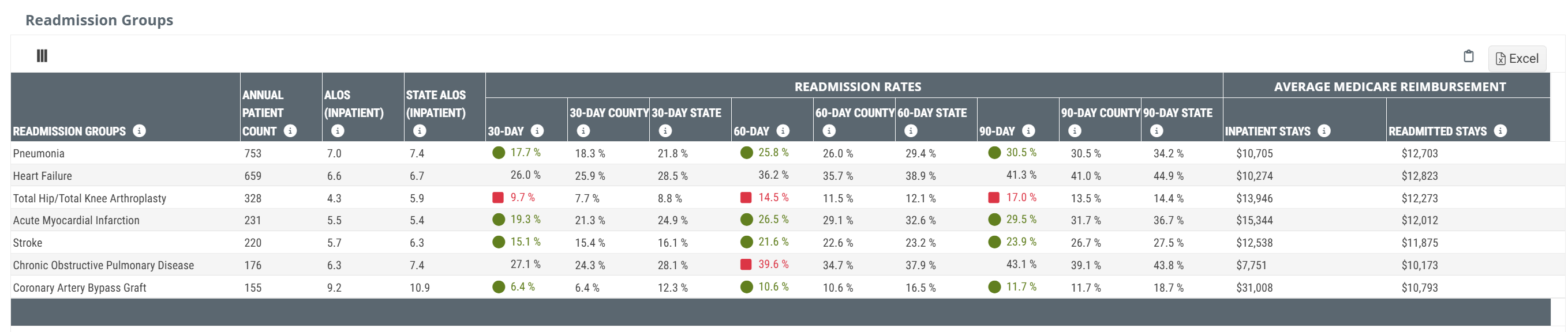
The Readmission Groups table shows patient counts, readmission rates, and Medicare reimbursement for patients admitted to the selected facility broken out by readmission groups.
Metrics Summary
- Readmission Groups - this column shows the readmission group for each row. Metrics in the same row are calculated from claims where the primary diagnosis aligns with the listed readmission group
- Annual Patient Count - the count of distinct patients admitted to the selected facility during the one-year reporting period whose primary diagnosis aligned with the listed readmission group
-
ALOS (Inpatient) - the average length of stay, in days, for patients discharged from the selected facility during the one-year reporting period whose primary diagnosis aligned with the listed readmission group
- State ALOS (Inpatient) - the average length of stay at all facilities in the same state as the selected facility for patients discharged during the one-year reporting period whose diagnosis aligned with the listed readmission group
-
Readmission Rates - the readmission rate for patients discharged during the two-year reporting period with a diagnosis that aligned with the listed readmission who were readmitted to inpatient care within 30, 60, and 90 days of the initial discharge
- County and State metrics - the matching 30, 60, and 90 day readmission rates for all facilities from the same state as the selected facility for patients discharged who were readmitted to inpatient care within 30, 60, and 90 days. These county and state metrics are included for comparison to the selected facility.
-
Average Medicare Reimbursement - the average Medicare reimbursement for all inpatient stays during the two-year reporting period for patients with diagnoses that align with the listed readmission group
- Readmitted Stays - the average Medicare reimbursement for patients discharged from the selected facility during the two-year reporting period whose diagnoses aligned with the listed readmission group who were readmitted to inpatient care within 30 days of discharge.
|
|
|